Membership in the legal profession carries with it inherent commitments to equal justice and public service. With its pro bono and public interest programs, along with its clinical programs, externships and the Marshall-Brennan Fellowship program, the law school demonstrates how ethical obligations can be fulfilled and how pro bono service can be woven into every legal career.
PHARS - The ProBono Hours and Activity Reporting System
Students can become involved in pro bono projects based at the law school or in external public interest organizations as early as their first year in law school. This early involvement, which enables students to use their developing legal skills, often leads to involvement in the credit granting clinical courses, Externship Program, and/or the Marshall-Brennan Fellowship Program.
Through pro bono and public interest involvement, Rutgers law students have the opportunity to work with legal practitioners, the courts and the public, and to share in the satisfaction of helping clients who have nowhere else to turn. Hallmarks of all projects include comprehensive training and ongoing supervision.
Pro Bono Award
While volunteering in the community is an end in itself, the law school honors significant pro bono service by recognition at graduation. The following guidelines have been established: (
click here for Pro Bono Award survey)
- Graduating 3Ls who have done at least 35 hours of pro bono service while at law school will be considered eligible for an award.
- At least ten of those hours must be during the third year of law school.
- Involvement in pro bono activities during one summer while at law school
can count toward this requirement, with prior approval from the Assistant Dean for Pro Bono and Public Interest Programs.
- Pro Bono Service must be given either through a law school sponsored
project or provided through an external public interest legal organization, i.e.
Homeless Advocacy Project, South Jersey Legal Services, Community
Health Law Project. In the case of the latter, the student must obtain prior authorization from the Assistant Dean for Pro Bono and Public Interest Programs and submit a summary of volunteer activity signed by a supervisor.
- Only activities which do not result in course credit or financial compensation
will be considered for a Pro Bono Award.
Pro Bono Projects
The
Bankruptcy Pro Bono Project is a cooperative effort of the law school, South Jersey Legal Services,
the U.S. Bankruptcy Court, District of New Jersey and the local bankruptcy bar. It provides bankruptcy representation for those in need of filing for Chapter 7 Bankruptcy relief who are not presently served by existing resources. (2L and 3L students)
The
Childrens SSI Project Project provides representation to children whose SSI applications have been denied, and students are paired with volunteer attorneys to work on these cases, which are referred from South Jersey Legal Services. All second and third year students are eligible.
The following documents are all in pdf format:
The
Community Dispute Resolution Committee (CDRC) is a joint effort of the New Jersey Courts and the law school. This is our Pro Bono Mediation Project; law students mediate disputes referred by Camden City Municipal Court or mediate small claims matters for Superior Court, Camden. Students involved in this mediation project receive formal training and New Jersey Court certification as trained mediators. (Second semester 1L, 2L, and 3L students)
The
Domestic Violence Pro Bono Project is a cooperative effort of the law school and the Camden County Bar Association's Family Law Section. The Project is designed to assist victims with the initial filing of a complaint, obtaining of a temporary restraining order, and the court appearance for the permanent restraining order. (Second semester 1L, 2L, and 3L students)
The
Immigration Pro Bono Project includes different opportunities: one is for students to assist attorneys from the Camden Center for Law and Social Justice with political asylum cases, another is to provide assistance to community members with immigration questions at the Camden Public Library, and another more limited opportunity is to work with clients seeking naturalization at the Nationalities Service Center in Philadelphia.
(2L and 3L students)
The
Pro Bono Research Project, co-directed by Professor Sarah Ricks, offers free legal research services to public interest law practitioners. The goal of the project is to match law student researchers with organizations that can benefit from the students' legal research skills. Students in this project may provide written or oral legal analysis or may gather legal research materials such as judicial decisions or legislation. Students must devote a minimum of 20 hours to the project - and those hours can be scheduled at the student's discretion - within one semester. A further explanation of the program can be read by opening the following pdf file,
click here. The application form to be printed out can be found by
clicking here.
(2L and 3L students)
The
Defender Project, which is limited to one or two students from Rutgers-Camden, as well as a limited number of students from each of the other Philadelphia area law schools, is an opportunity for students to assist with investigation, brief writing, and research on death penalty cases. Substantive training will be provided. An application can be found by
clicking here (2L and 3L students)
The
Volunteer Income Tax Assistance Project trains students to assist low-income Camden residents in filling out their tax returns. Students make assistance available for three months prior to April 15th at community locations two nights a week, and on some Saturday mornings.
(All students who complete training)
The
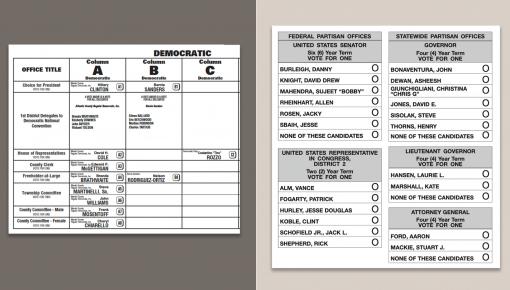
Voters' Rights Project gives training in basic election law and students then have the opportunity to assist civic groups with voting day monitoring efforts.
(All students who complete training)
The
Financial Literacy Project FLiP, gives students who have received training the opportunity to speak to groups of high school students about the true cost of credit card debt. Sponsored by the Camden bankruptcy bar, this project seeks to educate teenagers about budgeting, financial planning, and related topics. (2L and 3L students), and also the Children's SSI Project, through which students assist pro bono attorneys representing disabled children who have been denied Supplemental Security Income.
Street Law is a program of practical, participatory education about law, democracy and human rights. Trained Rutgers law students (3L's, 2L's and second-semester 1L's) go into the community to teach disadvantaged young people about the law in their lives. Street Law students make presentations at Camden-area high schools, detention centers, a homeless shelter and community organizations. They deliver lively lesson plans on relevant, thought-provoking law-related topics such as "Should it be a Crime?" and "What Happens in an Arrest?" Working in pairs, alone or in groups, Street Law volunteers commit to approximately three presentations per semester, though many students choose to present more.
Program Administration
The Law School's Assistant Dean for Pro Bono and Public Interest Programs and the Pro Bono Coordinator oversee existing pro bono initiatives, support public interest programs and develop resources and new opportunities for Rutgers students. Jill Friedman, Esq. directs the Street Law Project and provides additional support for other pro bono projects. An Advisory Committee, chaired by the Assistant Dean and including the student leadership of APIL and the law school's pro bono projects, the Directors of the Clinical and Externship Programs, selected faculty members and community representatives, provides guidance and support for pro bono and public interest activities at the law school. It also gives support for APIL's annual Public Interest Auction, which provides funding for summer public interest fellowships.